

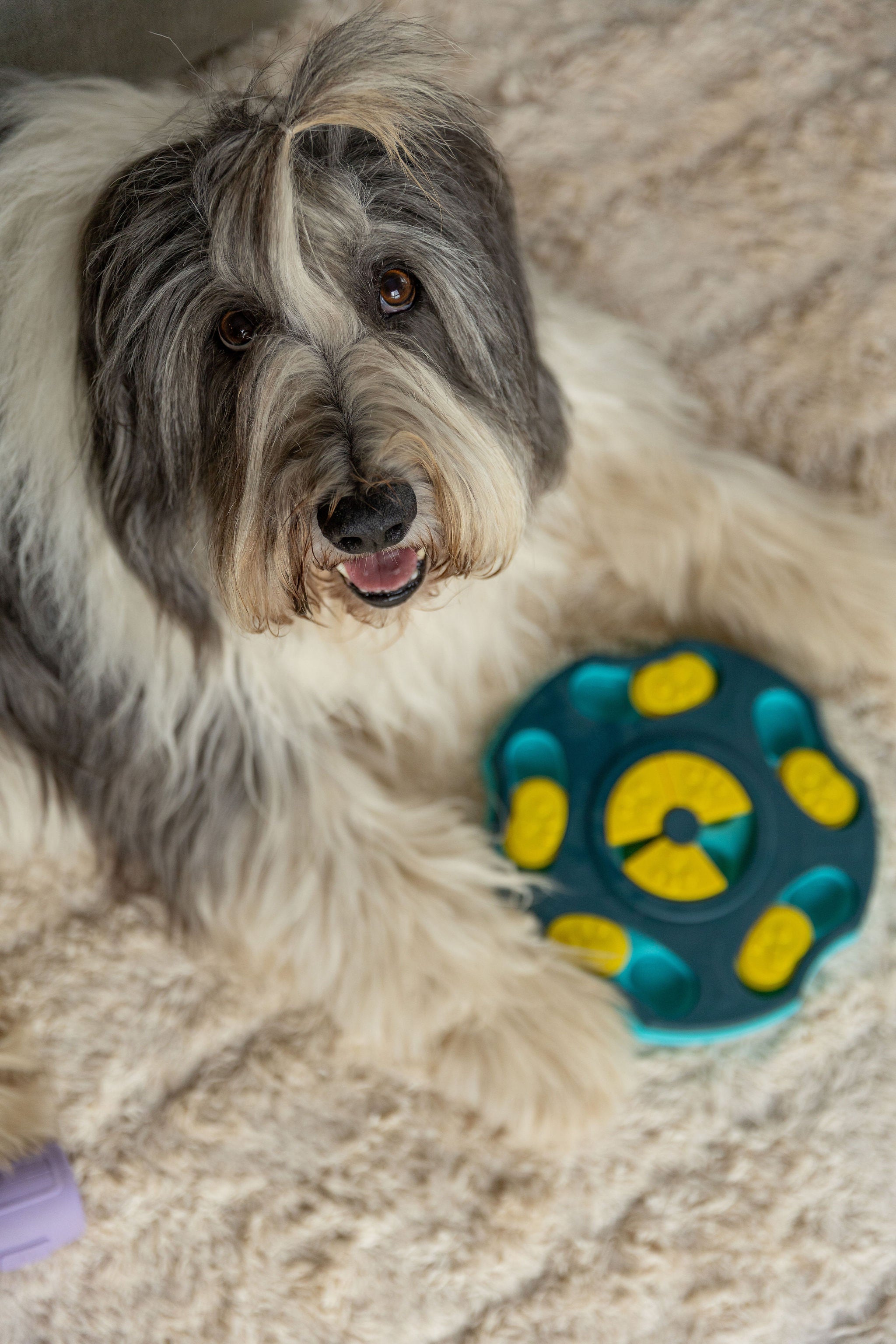
“My dog finished it in 4 seconds…”
We hear this one a lot.
“They figured it out straight away.”
“Too smart. Solved it in seconds.”
And here’s the part most people don’t expect us to say:
👉 That doesn’t mean the puzzle failed.
👉 It means it did its job.
At CleverTails, we’re not in the business of trying to outsmart your dog forever. We’re here to exercise their brain, not frustrate it.
Let’s unpack why solving a puzzle quickly is still incredibly valuable — and what’s actually happening in your dog’s brain.
The goal isn’t “how long it takes” — it’s what it activates
Humans tend to measure enrichment by time.
Longer = better, right?
Not quite.
Mental enrichment works more like a brain workout than a time filler. A short, focused challenge can be just as (or more) effective than something that drags on.
When your dog approaches a puzzle, they’re engaging:
-
Problem-solving skills
-
Memory and learning
-
Cause-and-effect reasoning
-
Sensory processing (sight, smell, touch)
Even if the solution comes quickly, the neural work still happened.
What science says about problem-solving in dogs
Research in canine cognition shows that:
-
Novel problem-solving tasks activate dopamine pathways, the same reward systems linked to motivation and satisfaction.
-
Dogs who regularly engage in cognitive challenges show improved learning speed and better emotional regulation.
-
Mental work can be as tiring as physical exercise, especially for working and high-drive breeds.
Research reviewing cognitive enrichment literature (e.g., Clark, referencing Buchanan‑Smith et al., 2016) found that animals often interact with mental challenge tasks only briefly, yet still show signs of benefiting from that interaction.
Translation?
Your dog doesn’t need to struggle for 20 minutes to benefit. They need the opportunity to think.
Smart dogs solve fast. That’s not a flaw.
If your dog cracks a puzzle quickly, it usually means:
✔ They’re confident problem-solvers
✔ They’ve learned how to learn
✔ They enjoy engaging with challenges
This is especially common in:
-
Border Collies (we’re looking at you 👀)
-
Kelpies
-
Shepherds
-
Poodles
-
Any dog bred to make decisions independently
For these dogs, success builds confidence, not boredom.
And confidence is a huge part of long-term behavioural wellbeing.
Why frustration isn’t the goal (and can backfire)
There’s a fine line between challenge and frustration.
Puzzles that are too hard can lead to:
-
Disengagement (they walk away)
-
Stress behaviours (pawing, whining, grabbing)
-
Learned helplessness (they stop trying)
Good enrichment should feel:
-
Achievable
-
Rewarding
-
Clear
A puzzle that your dog solves — even quickly — reinforces:
🧩 “I can figure things out.”
🧩 “Trying leads to success.”
That mindset carries into training, new environments, and everyday life.
Want to make it harder? That’s where you come in
If your dog is breezing through puzzles, that’s your cue to level up the environment, not blame the toy.
Try this:
-
Freeze the filling
-
Combine multiple enrichment items
-
Change the location (new room = new context)
-
Level up to a harder puzzle
-
Ask for calm behaviour before offering the puzzle
Enrichment isn’t static. It’s meant to evolve with your dog.
The CleverTails philosophy
We provide puzzles to:
✔ Encourage thinking
✔ Build confidence
✔ Support calm, fulfilled behaviour
Not to “beat” your dog.
If your dog solves it in 4 seconds and walks away relaxed, satisfied, and mentally worked?
That’s enrichment working exactly as intended.
And honestly?
A dog who solves problems is a dog who’s learning how to cope with the world.
That’s a win we’ll take every time.
— CleverTails 🐾
Sources:
Buchanan-Smith, H. M., Vick, S. J., Morton, F. B., & Herrelko, E. S. (2016). Environmental enrichment: Our cognitive challenges [Abstract]
Clark, F. E. (2017). Cognitive enrichment and welfare: Current approaches and future directions. Animal Behavior and Cognition, 4(1), 52–71. doi:10.12966/abc.05.02.2017