

Your dog has a full bowl of food, a comfortable bed, a backyard to roam, and you home more often than not. By most measures, they’ve got it pretty good. So why are they chewing the furniture, barking at nothing, following you to the bathroom, and generally acting like a small furry chaos agent?
The answer, more often than not, is boredom.
Dog boredom is one of the most misunderstood and underestimated problems in pet ownership. It’s not a personality flaw or a training failure , it’s a basic unmet need. And once you understand what’s actually going on, the fix becomes a lot clearer.
What boredom actually is in dogs
Boredom in dogs isn’t just about having nothing to do. It’s about having a brain that’s built for activity, problem-solving, and engagement, and not getting enough of it.
Dogs evolved alongside humans as working animals. Even the most pampered modern dog carries the cognitive and physical drives of their ancestors, to track, hunt, herd, retrieve, guard, or problem-solve, depending on their breed. Those drives don’t disappear just because the job has. They still need an outlet.
When a dog’s mental and physical needs consistently go unmet, boredom sets in. And a bored dog doesn’t just sit quietly and wait for something to happen, they find their own stimulation. That’s where the furniture chewing, the excessive barking, the hole-digging, and the general household destruction comes from. It’s not naughtiness. It’s a dog doing what dogs do when they’re under-stimulated.
Signs your dog is bored (and not just being ‘naughty’)
Boredom in dogs shows up in a surprisingly wide range of behaviours. Some are obvious, others are easy to misread. Here’s what to look for:
Destructive behaviour
Chewing furniture, shoes, or anything left within reach. Digging up the garden. Shredding cushions. This is the most well-known sign of boredom, and it makes sense, destruction is mentally engaging. A dog that’s dismantling your couch is a dog whose brain is working hard, just not in a direction you’d choose.
Excessive barking or whining
Barking at nothing, whining for no apparent reason, or vocalising persistently even when their basic needs are met. Dogs that are bored will often bark as a form of self-stimulation, the noise is something, and something is better than nothing.
Attention-seeking and clinginess
Constantly nudging you, following you from room to room, pawing at you during activities, jumping up repeatedly. A bored dog has figured out that annoying you reliably produces a response, and any attention is better than none.
Restlessness and pacing
An inability to settle, circling, or pacing back and forth. This often gets labelled as anxiety, and while the two can overlap, boredom is frequently the underlying cause. A dog that can’t find anything to engage with will physically manifest that restlessness.
Lethargy followed by zoomies
A dog that sleeps all day and then goes absolutely feral at 6pm is often a bored dog that’s been storing energy. The evening zoomies are the release valve for a brain and body that haven’t had enough to do all day.
Over-excitement at minor stimuli
Losing the plot every time someone walks past the house, going into overdrive when the lead comes out, explosive reactions to things that don’t seem to warrant it. When a dog’s baseline stimulation is very low, even small events feel enormous.
Why a daily walk isn’t always enough
The most common response to a bored dog is more exercise. And while physical activity absolutely matters, it’s only half the picture.
A dog’s brain needs as much of a workout as their body. Mental stimulation, problem-solving, sniffing, learning, figuring things out, is genuinely tiring in a way that physical exercise alone can’t replicate. Research into canine cognition consistently shows that mental enrichment reduces stress behaviours, improves focus, and contributes to overall wellbeing.
Think about it this way: you could go for a run every morning and still be bored out of your mind if you had nothing else to engage with. Dogs are the same. Physical exercise takes the edge off, but it doesn’t substitute for cognitive engagement.
What actually helps: meeting your dog’s mental needs
The good news is that addressing dog boredom doesn’t require hours of your time or an expensive overhaul of your routine. It requires consistency and the right tools. Here’s where to start:
• Sniff-focused walks. Let your dog lead the walk at nose pace. A 20-minute sniff-heavy walk is mentally more tiring than a 45-minute power walk where they’re constantly being redirected. Their nose is processing an enormous amount of information, give them time to use it.
• Training sessions. Even five minutes of focused training works the brain hard. It doesn’t have to be complex, sit, stay, drop, leave it, or a new trick all count. The combination of mental effort and positive reinforcement is genuinely satisfying for dogs.
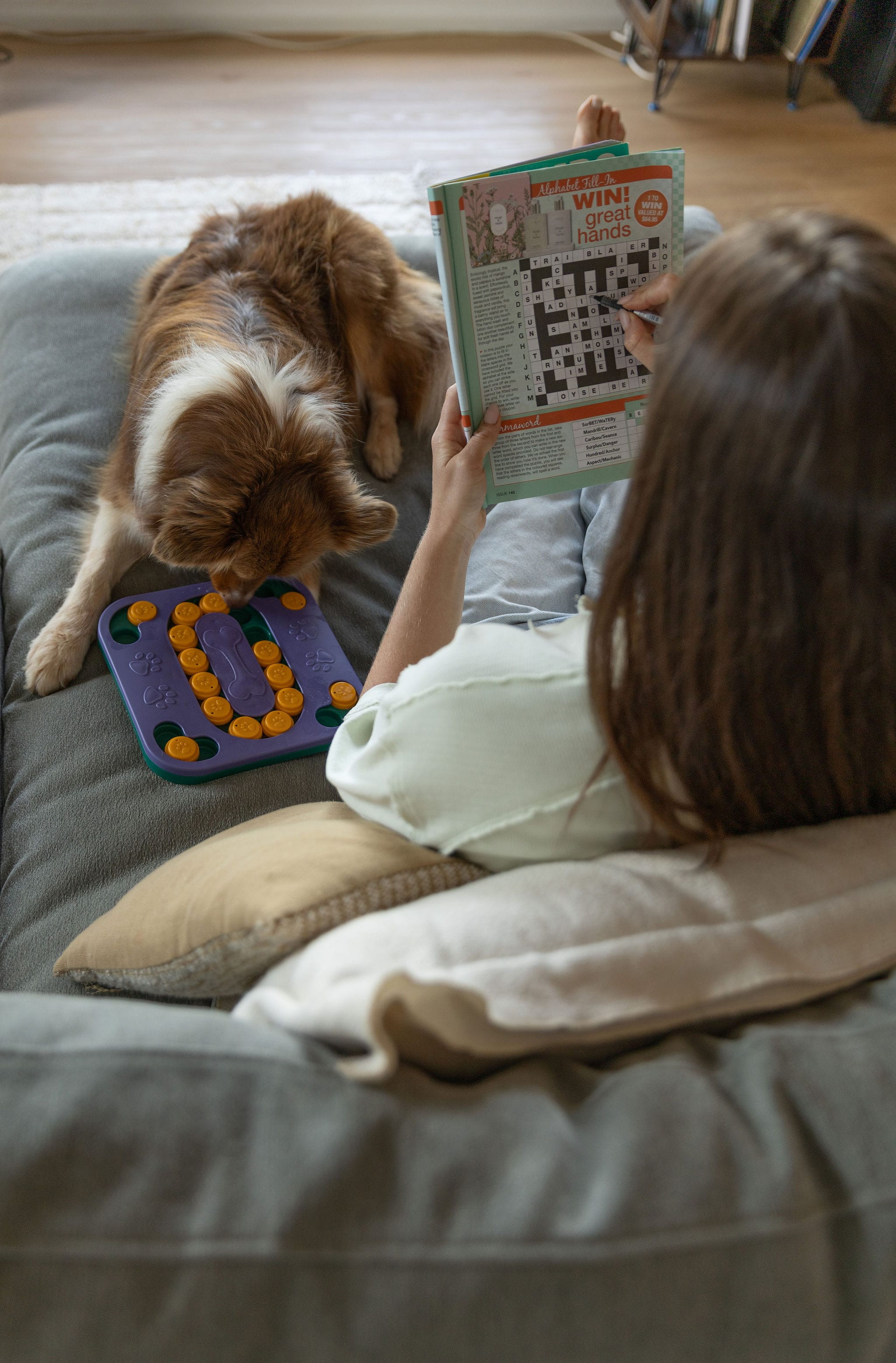
• Enrichment toys and feeders. Replacing part or all of your dog’s meals with an enrichment toy or puzzle feeder turns eating into a mentally engaging activity. A dog that has to work for their food is a dog whose brain is switched on. Look for toys that offer genuine challenge, not just ones where treats fall out with minimal effort.
• Scatter feeding and snuffle mats. Scatter your dog’s kibble across the backyard or into a snuffle mat instead of serving it in a bowl. This activates their foraging instincts and takes dramatically longer than eating from a bowl, which means more time engaged and less time looking for something else to do.
• Novelty and variety. New smells, new environments, new objects to investigate. Even something as simple as bringing home a paper bag with interesting smells on it can keep a curious dog occupied. Dogs are novelty-seeking animals, small doses of new experience go a long way.
How much enrichment does a dog actually need?
This varies a lot by breed, age, and individual temperament. A working breed like a Border Collie or Kelpie has significantly higher cognitive needs than a Basset Hound or a Bulldog. Young dogs generally need more stimulation than older ones. And some dogs are just wired for more; they’re the ones who need three activities before breakfast.
A useful starting point for most dogs is at least one dedicated enrichment activity per day, something that requires active mental engagement, not just passive entertainment. This might be a puzzle feeder at breakfast, a sniff walks in the afternoon, and a short training session before dinner. For high-drive breeds, more is usually better.
The best indicator that you’ve got the balance right? A dog that can genuinely settle. A well-enriched dog isn’t one that’s constantly hyped up, it’s one that has an appropriate outlet for their energy and can switch off when there’s nothing to do.
Start small, stay consistent
You don’t need to overhaul your entire routine to address dog boredom. Small, consistent changes make a big difference. Swap the bowl for an enrichment feeder a few times a week. Add ten minutes of sniff time to your morning walk. Run through a few commands before dinner.
Most owners notice a shift in their dog’s behaviour within a week or two of introducing regular enrichment. Less destructive behaviour. Better ability to settle. Fewer attention-seeking interruptions. A calmer, more content dog overall.
At CleverTails, enrichment is the whole point. Our toys are designed to give your dog’s brain a genuine workout , the kind that leaves them satisfied rather than still searching for something to do. Browse the range and find the right fit for your dog.